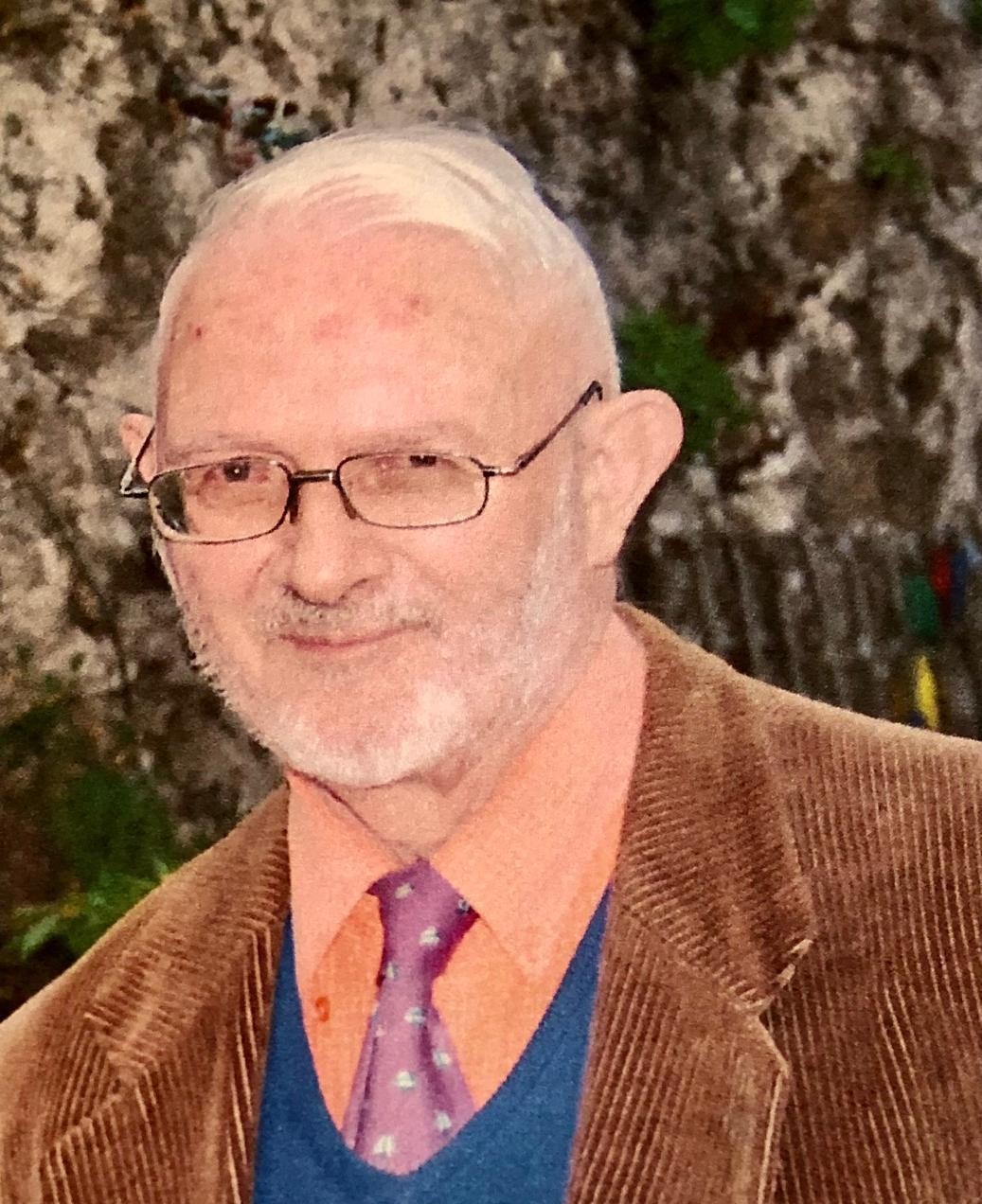
Obituaries

This page honours and celebrates the lives of Old Members, academics, staff, and friends of Balliol. We hope it will provide a lasting and accessible record of those connected to the College, while also offering a space for reflection and remembrance of their achievements, contributions, friendships, and the many ways in which they shaped the life of Balliol and the wider world.

The obituaries currently available on this page have been drawn from previous editions of the Annual Record, as well as from publicly available obituaries published elsewhere online. This page is still in development, and we hope over time to build a more comprehensive record.

If you would like to submit an obituary of a Balliol member, please contact the Development Office at: development.​office@​balliol.​ox.​ac.​uk.

Denis Cross

1955, BA Mathematics, DPhil Mathematics
13 May 1938 — 27 November 2025

Charles Humphreys (1956)

Denis was a dazzling mathematician who won a scholarship to Balliol when he was only 17 and stayed on to do a DPhil, which happened to take him beyond the abolition of national service. In 1961, he joined the Investment Management Department at Hambros, a family merchant bank founded by a Norwegian in 1839. It is said that, opening his eyes at his desk after a good lunch, he found a note from the chairman: ‘See me when you wake up’. The ethos suited Denis and he was to spend his entire working life there. He moved to the Corporate Finance Department, working on mergers and acquisitions and corporate equity funding where, according to a colleague, he became ‘our mathematics guru, brilliant at analysing balance sheets and complex corporate structures.’ He became a director and was called upon to deploy all of those skills when the Norwegian shipping magnate, Helmar Recksten, was giving Hambros the run-around during the 1970s.

Perhaps his most demanding task came in 1984 when a Hong Kong conglomerate, called the Carrian Group, went bust amid allegations of serial fraud and bribery. It was the largest bankruptcy the then colony had ever seen and Denis spent six months there helping over-indebted companies to ride the tsunami. The stakes were high. Not long after his arrival, the senior partner of Carrian’s lawyers was found at the bottom of his swimming pool tied to a manhole cover.  But Denis stuck it out till the job was done.

He didn’t hold, and almost certainly didn’t seek, general managerial responsibility. Rather he was an Aladdin, whose analytical skills were called upon, not just in his own department but elsewhere in the group, when others were stuck. One colleague says: ‘We were regularly reminded of his mental agility by his continued use of a Curta mechanical hand-held calculator. But his appreciation of good food, fine wine and cigars did not always conform to the time pressures of merchant banking.’ That deviance became more noticeable after Big Bang and, when Hambros was devoured by Société Générale in 1997, he played his last round of croquet on the court he had helped his boss to create over Hambros’ car park at Tower Hill, and retired.

Denis was born 16 months before the Second World War  was declared. His mother, Geraldine, daughter of Major Denis Burke, was a keen sailor and had met his father, Philip, on the Isle of Wight when he was serving as emergency crew on her yacht, Katinka. On 10 April 1940, before Denis was two years old, his father was killed at the first Battle of Narvik. His younger brother, Mick, was not yet born. The boys grew up with their mother at the aptly, if unexpectedly, named Primrose Cottage in Drayton Gardens and, after the war, in the Isle of Wight. Geraldine bought him Skylark the Famous Scow, which he continued to sail – having, at one time or another, renewed every part of it – until his 80s. She was also to be seen at Crockfords and infected her son with a love of cards. 

Denis was educated at Worth (then just a prep school) followed by Downside, for which he expressed little affection though he flourished academically and remained a Catholic throughout his life. There are no reported sightings of Denis actually running but he was an energetic walker, a keen swimmer, a high-handicap golfer and, above all, a croquet player. His love of croquet was conceived among the divots of Balliol quad but flourished on the baize of Hurlingham where he became Chairman of Croquet. Denis’s room on Staircase XIII also gave birth to a poker school and Floreat Domus for Spring 2017 carried an account of how he managed to continue to organise this enterprise, with four of its original players, for 60 years without a break. Many a Denis adage – ‘better to be wrong than slow’, ‘if you can see, you can raise’, ‘I seem to have hit a snag’ – will, for years to come, be quoted by those who have handled his chips. 

He was among the Balliol Players who toured Aristophanes’ Peace in the summer of 1959. Clad as a middle-aged peasant’s wife, he delivered a spirited rendering of: ‘Up the ‘ills and down the dales/ We’re the jolly old archers/ We move no faster than the snails/ Or Aldermaston marchers’ – to the signature tune of a recent radio serial. He enjoyed performing and appeared in many Hurlingham plays and musicals. He never swore in private life but, given the role of the lead’s MP father in ‘Feel Good’, did so with relish; ‘it’s all right for the sake of art’. 

It was through a joint Balliol-LMH production that he met Margaret MacAdam Black, known by her initials, Emma, to distinguish her from another Margaret Black. She was LMH’s wardrobe mistress. They married in 1963 and went on to have five children: Katharine, a civil servant now retired; Felicity, a dentist; James, a patent attorney; Frances, a midwife; and Thomas, a solicitor. There are 12 grandchildren; reduced to a Denis-type formula, the score, in order, is 2/1/4/2/3. Any one of them old enough to hold a hand of cards will surely know how to play poker and have been schooled in Denis’s first commandment – ‘No babies may cry’.

In the 1970s, Emma had hospital treatment which, for many years, did not trouble her. From her late 60s, however, the latent damage progressively reduced her mobility. First, she needed someone to shuffle for her; eventually it was Denis who did the cooking (under her direction). She bore it stoically and he cheerfully picked up each new task with no complaints. It is hard to imagine a more devoted couple. They downsized from the family pile in Bolingbroke Grove to a five-bedroom house in Hendham Road but, when Emma died in 2021, she left a big hole. Denis had his own problems. In 2018, he broke a bone in his foot in a bathroom tumble and, over the ensuing years, his ageing knees were giving him enough grief for him to want surgery. But he had never been one to mope; most problems could be overcome over a good meal and a glass of wine, and his family have been wonderfully supportive. As a Hambros friend expressed it: ‘We have lost one of the last cigar-smoking dinosaurs.’ 

Neil Tasker

1951, BA Modern History
20 November 1932 — 29 September 2025

The College is greatly saddened to learn of the death of Neil Tasker. An obituary can be found at the following website:

Neil TASKER Obituary (2025) - Shropshire Star

Sir Jeremy Lever

1953, BA Jurisprudence
23 June 1933 — 24 August 2025

It is with sadness that the College report the death of Sir Jeremy Lever. 

An obituary can be found at the following website:

https://announcements.telegraph.co.uk/marketplace/advert/lever-notices_63732

Barry Day

1953, BA English Language and Literature
27 April 1934 — 23 June 2025

Lynne Day 

Barry Day was born in Lincoln. He read English at Balliol, where he notably edited ISIS during his time there. After graduation, he began his career as a trainee for Unilever, eventually rising to Creative Director at Lintas. In 1971, he joined McCann Erickson as Creative Director in London, later expanding his role to Europe. During this period, he created iconic campaigns including the Martini ‘Balloons’ advertisement and the memorable ‘I can’t tell stork from butter’. In 1981, he moved to New York as McCann Erickson’s Worldwide Creative Director, travelling extensively to direct creative output across the globe. 

He was part of the campaign team, alongside James Garrett, that Edward Heath chose to direct his successful bid for Prime Minister. Recognised as an advertising guru, he frequently gave talks on the sector, working with major brands including Nestle, Unilever, Coca Cola, and Martini. In the 1990s, he joined the board of the Shakespeare’s Globe Theatre and wrote an account of his first meeting with Sam Wanamaker. His book This Wooden ‘O’ chronicles the difficult path to the triumphant building on Bankside, London, which was eventually opened by Queen Elizabeth. 

At sixty, Barry retired from advertising to become a full-time author. He wrote ten books on the life and work of Sir Noël Coward. With the full support of Coward’s heir, Graham Payn, he was granted total access to the Coward archives in Switzerland. His books include Coward Letters (featured on the cover of the New York Times Book Section!), Coward On Film, The Complete Lyrics, Noël Coward on (and in) Theatre, and My Life with Noël Coward. He also wrote books about Raymond Chandler, Oscar Wilde, and PG Wodehouse, establishing himself as a prolific author. 

He was awarded an OBE by Queen Elizabeth for services to British Culture in the USA and served as Chairman of The Noël Coward Archive. He combined an unusual set of skills: a creative writer with the eye of an archivist. He was always so proud of his time at Balliol, becoming an illustrious figure through his many accomplishments. He was also known for his brilliant wit and sense of humour. 

He is survived by his wife of 45 years, Lynne Carey, his daughter Elinor, and his son Charles.

Ian Mertling-Blake

1965, DPhil Archaeology
5 November 1930 — 9 June 2025

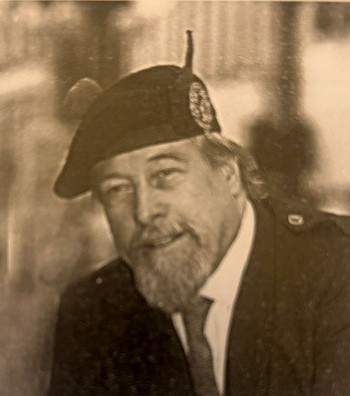
Ian Mertling-BlakeSir Michael Burton (1965)

This is an edited version of a eulogy given at Ian Mertling-Blake’s memorial service at Charterhouse Founders Chapel on 6 December 2025.

Ian was a great friend but a true literary giant – poet, author, playwright, actor, teacher – and a powerful James Robertson Justice lookalike.

Here, I deal only with the more thespian aspects of his life. These began at Trinity College Dublin, where he was heavily involved in drama with the later film director Michael Bogdanov (or Mike Bogdin, as Ian and everyone else knew him then). He also wrote short stories for The Dubliner, and later became archaeological correspondent for The Irish Times.

But I first knew him at Balliol. By then, he was already involved in important archaeological digs around the Dead Sea in Jordan and Israel, so he was not just older than us but much more of a man of the world. Even so, he found time for drama at Balliol – he wrote and directed a play called The Meeting, directed The Waste Land, and, astoundingly, directed Oedipus in Greek. 

He also wrote a marvellous script that formed the backbone of the Balliol Players on Tour in 1967: Tis Pity She’s the Merry Wife of Good King Wenceslas the Fourth Part 2, or rather, as it eventually became, Part 2B and Part Not 2B. It overflowed with non-Shakespearean characters such as Claret, Moselle, Burgundy, and Hock, together with their bastard sons – ‘Hail Bastards All!’ – alongside the much-persecuted Good King Wenceslas, his page, and the lovely St Agnes with her fountain. All were, of course, part of our rendition of Aristophanes at schools such as Charterhouse.

There was another of his triumphant farce scenes in the 1969 Players production, in which I, as Viscount Babycham, and my inamoratus Lady Fiona Fitzgropeswothy, were faced with everything being ‘second on the left up the stairs’. 

Ian’s experiences in Jordan led to a children’s book called The Marvellous Adventure of Edward and the Magic Scarab. Later, in London, we wrote and put on a Pantomime, Aladdin, in which he was the Grand Vizier, and he wrote a marvellously built-up scene for me as Wicked Uncle Ebenezer, instructing Aladdin on how to enter the cave, always greeted by a crescendo of laughs.

After Balliol, Ian joined Charterhouse as Master and later Housemaster, happily spending the remainder of his professional career there. Alongside his teaching, he was lured by the school’s wonderful theatre, where he both acted and directed. He also took charge of its museum, completely reorganising its collections. In the process, he made an interesting discovery, which he published in the Times Literary Supplement in 2003. He discovered a Greek papyrus in the museum, which told the story of an eight-year-old Greek slave who had fallen to his death through a window while watching castanet dancers. Having read Richard Hughes’s 1929 novel called A High Wind in Jamaica, Ian recognised that the papyrus had almost certainly inspired one of the novel’s most memorable scenes, in which a young boy falls to his death though a window. Hughes, himself a Carthusian, must have seen the papyrus in the museum while at school. Ian later published his own poem in The Spectator called Incident at Senepta, which ended:


To you it must have seemed a Paradise
Inviting you to lean out, enter it:
Your small arrival silenced the castanets.


At Charterhouse, Ian inspired generations of pupils, among them the novelist Guy Burt, who wrote of Ian as a major influence on him, and Sir Jeremy Hunt, who nearly became Prime Minister. During this period, Ian also wrote Blincoe, a play with a workhouse connection to Charterhouse.

Life did not stop when Ian finally left Charterhouse after 23 years: he simply moved his base to Gairloch, where, apart from writing, he became the revered President of the Clan Mackenzie Society.

Every Christmas, his many friends would look forward to one of his specially composed Tales from the Other Side. I have 32 of them from 1994. Each year a different mystery: The Archaeologist’s Tale, The Schoolmarm’s Tale, The Climber’s Tale, The Motorist’s Tale, The Housemaster’s Tale, The Innkeeper’s Tale, The Poet’s Tale, The Sailor’s Tale, The Cyclist’s Tale, The Accountant’s Tale – and many more! 

Then there were his published books: School Story (2015), written under the name Ian Mckenzie Blair, a gripping story of a public school which he always denied was based on Charterhouse; and The Guardians (2018), a sinister but beautiful story set in a Canadian trading post.

But above all, there were his poems. I very much enjoyed his Browning-style sequel to The Pied Piper of Hamelin – The Return of the Piper to Hamelin – without the children – and his trial. Ian and I twice performed this, with the audience acting as the jury. The Piper made clear that ‘Only he who pays the piper calls the Tune.’

There was such a marvellously varied selection of poems which he published in slim volumes – about Falstaff, Desperate Dan, Swallows and Amazons, PG Wodehouse, Nessie, Sherlock Holmes and Watson, and Shirley Temple. Alongside these were wonderfully moving poems, including The Bombing of Dresden and the astonishing narrative poem of Nazi horror, The Flight into Egypt. My favourite, however, was inspired by a sepia photograph of Jews being rounded up by the Nazis on a Budapest street in March 1944. Although I have tried to trace the original photograph without success, Ian brought the scene vividly to life in his poem, Sepia Tones, March 1944. An extract from the poem follows:


Budapest, Hungarian jews, March, 1944,
reaches out in terrible sepia
from far beyond the distant corner there,
through the frontage of the photograph
and into us for ever.
The war has only fourteen months to go,
We know it. They will never.

Neat ankle-socked against the chill, well shod,
(pavement municipally cleansed of snow)
an endless column,
of thoroughly respectable Hausfrauen,
ordinary mothers, anyone might meet
in this or any other fashionable street
of thoroughly respectable shops
soliciting their custom
as they go to choose
their fashionable warm overcoats,
smart hats and comfortable shoes.

Only one retains her handbag.
Long-strapped,
it can be shoulder-slung;
but with the bagless ladies
she too walks along,
her hands held shoulder-high like theirs,
palms out, hope gone, surrendering:
supplicants’ humble obeisance;
implacable heedless god.

Carrying their handbags, other fashionably dress
women – drifting leisurely out of banks,
patronising all the fashionable shops,
dawdling into cafes for ersatz chocolate cake -
scarcely glance across the road, but pass
by on the other side, looking the other way.

Slightly out of focus, in the middle of the road,
one solitary soft-peak-capped, shabbily-uniformed man,
relaxed, chats-up inquisitive passers-by
avid for gossip, rumour, Official Views:
‘Those women over there, what have they done?’
‘No need for you to worry, sir, they’re only Jews.’
‘About time we taught that lot to behave!’
Gulf wider than the sky, the ocean and the grave.

She’s looking at me…Surely she can’t see
back down the lens as clear as I see her

Perhaps fourteen,
(She should be choosing frocks across the way,
a grown-up dress for her first formal dance.
A shutter-clicks. Another step,
she’s vanished from the picture through the frame
into this Danse Macabre
in time for The Last Waltz
towards a future she knows, for her, may
hold no future.)
       she’d be seventy-five,
a gracious grandmother maybe, were she alive
and cherished by her family, to-day.

Is that a younger brother, to her left,
half-hidden, gazing glumly at his feet?
Behind him others plod on stolidly,
stare unthinking, blankly, straight-ahead,
or down in nun-like custody of eyes.
Faces stoic in their dull despair,
they walk as if arisen
although they are not yet dead.
One woman only, looks across the street,
glimpses perhaps a well-remembered face
until to-day a next-door neighbour — friend -
who will not (dare not?) now acknowledge her.

The girl looks neither straight-ahead, nor down,
but out into the camera. And me.
Heavy-lidded eyes. Tears? Not slept well?
Rounded-up, held somewhere overnight?
Dawn-rousted from her snug suburban bed
to go to god knows where.
(But God is dead.)

Incomprehension in her silent cry,
last spark of childish curiosity
which momentarily lights-up her glance.
Why me? What have we done?
Why us? And why do you
need to record our shame, emulsify
our final walk through our own city streets
humiliated by this public show?

Oh girl, girl, stepping out of history books
and into history,
whose name I do not know,
your look of sad, half-quizzical contempt,
condemns me on the sepia evidence
of one March morning sixty years ago.


I finish with two of his shorter poems. The first is an imagined dialogue between parent and child, Anthem for Oldies:


We’re all falling to pieces,
Now we’re getting old.
Bits off here, bits out there,
Bits from bloody everywhere;
Fallen arches, falling hair,
Specs, false teeth and a dodgy ear.
We’re all falling to pieces
Now we’re getting old

Of course you are falling to pieces,
Now you are getting old.
Of course your knees won’t work the same
As when, yonks ago, you ‘saved the game’!
Next you’ll be needing a simmer frame
And forgetting your favourite grandson’s name.
That’s what felling to pieces means
Now you are getting old.

We may be falling to pieces.
We may be getting old.
But we’ve paid the last of our mortgage off.
And can walk round the house, if we wish, in the buff.
You complain you pay for our pensions?
Tough!
We paid for your schooling long enough.
Three cheers for falling to pieces!
Hurrah for getting old!


And finally, In the End:


In the end it all comes down to this:
a book, a pot of tea, old cat before the fire,
chair-side lamp, thick curtains closely drawn;
winter safely locked away outside
north wind soughing through the telephone wire.
Those years it seemed important ‘to get on’,
we didn’t realise we’d be content with this,
when it came the moment to retire.


Even now, I still expect that we will receive next Christmas a card from the Other Side called The Gravedigger’s Tale but subject to that, I want to say thank you to Ian for a life well lived and a friendship much enjoyed and cherished.

Norman Coles

1957, BA Philosophy, Politics and Economics
21 September 1939 — 03 May 2025

Revd Paul King (1958)

Norman ColesOld Members of the College demonstrate their attachment to Balliol in various ways. Some make generous benefactions, and their names are written in stone. Others are commemorated in more subtle ways – ‘Junior fui…’ each generation which enters Hall is mysteriously informed. Norman Coles, who died on 3 May 2025, expressed his affection and gratitude for the College, which was very great, by a constant stream of correspondence, writing on one side of the paper only, and more or less on the diagonal. (Despite being placed, in 1962, in the First Class in PPE, the computer and e-mail were beyond him.). The sad news took some time to reach the College; the Master’s instant response, ‘I wondered why I hadn’t heard from him for some time’. He was a devoted participant in the Balliol Society Weekend, and his affection for the College was reciprocated in recent years not only by the Master, but in the Development Office also, and, not least, by the Porters’ Lodge.
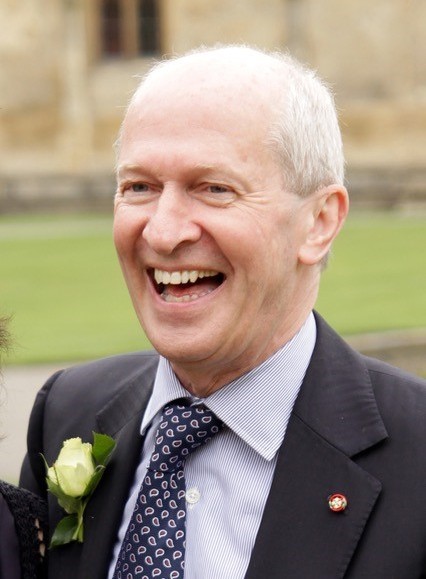
His first academic post was as a Lecturer in Philosophy at Trinity College, Dublin, where he remained until 1970, when he married Janet, who came from Cork. He was subsequently for fifteen years a Senior Lecturer in Philosophy at the North London Polytechnic, including a year spent at Cornell University as a Fellow of the Sage School of Philosophy. He retired from the North London Polytechnic in 1990 due to ill-health. In 1995, he and his wife moved to Hastings. The death of his wife in 2012 was a terrible blow. She had suggested to him that he should move back to Oxford, which he did briefly, but subsequently returned to Hastings where there was a supportive community. In retirement, he published books on a typically idiosyncratic range of subjects – James II’s right of succession, Isaiah Berlin’s understanding of human nature, and aspects of American politics. Those who knew him will miss this constantly curious, gentle, warm-hearted eccentric.

Chris Allsopp

1960, BA Physics
06 April 1941 — 05 March 2025

Andrew Graham (Fellow and Tutor in Economics 1969–2001, Master 2001 2011, Honorary Fellow) 

Chris Allsopp was born on 6 April 1941 and came via the Bootham School in Yorkshire to Balliol in 1960 where he studied Physics and then an MPhil in Economics. Following a short period in the Treasury (as Nicky Kaldor’s assistant), he was appointed in 1967 to a Fellowship at New College.

Subsequently, he taught numerous Balliol students for the special paper in Economic Theory. 

I first met Chris in his Kaldor period. I liked him but found him puzzling. He had a wonderful smile, but spoke in a manner that was at once elusive, suggestive, and provocative, often ending with a slight raising of an eyebrow or a ‘Hmm?’ Clearly clever, but what did it mean? 

Working alongside Chris for several years on the Oxford University Business Summer School, I saw how stimulating a tutor he could be and how rare he was as an economist. He used theory – all the time – but was never controlled by it, still less by mathematical models. He was not a neoclassical economist, but I recall his advice: chase the market failure to its lair. Twenty years after I met him, life went full circle. A somewhat secret ‘Kaldor Group’, supposedly advising Kinnock, was formed. Initially it was Kaldor, Wilfred Beckerman, Tony Atkinson and me. I immediately suggested that Chris joined the group – an invaluable addition. 

Chris’s ability to comprehend and analyse real world problems led to him advising not only the UK, but also the OECD, Poland and China. Among many insights, his most significant contribution was his understanding of the 1973 oil shock. With OPEC restricting oil supplies, initially everyone saw it as a supply shock. At a long meeting in Oxford, the sole dissenting voice was Chris. He argued that it was a demand shock. Eventually, others saw his point – the quadrupling of oil prices being equivalent to a large increase in indirect taxation. 

A second touch of genius was his work on fiscal policy. Everyone knew that, faced with unemployment, the government should increase the budget deficit. What Chis pinpointed was the credibility problem, because financial markets viewed this as going in the ‘wrong’ direction. Chris demonstrated this brilliantly: having students balance a pencil on a finger and asking which way they had to move their finger to move the top of the pencil in the desired direction! 

Having studied physics, Chris had mathematical ability to spare. However, like Marshall, this was kept firmly in the background. The Keynesian multiplier, he commented, is just the maths of game theory, but, seen thus, it is much less interesting. From his physics, Chris also brought an intuitive understanding of stock and flows, (and of assets and liabilities) unmatched by any other economist I’ve known. In conversation, the insights were multiple: his understandings of expectations in financial markets and in macroeconomics; his predictions about when the OPEC cartel would collapse; plus a suggestion that China might be underestimating its growth rate because of a mistake about index numbers. 

Common to all was Chris’s willingness combined with his ability to think things out for himself, unconstrained and un-befuddled by what any mathematical model might claim to show. 

As a friend I miss him enormously. As an economist, I feel I’ve lost my lodestar. He was, in my view, the most original and insightful UK applied economist of his generation.

Professor Graham Richards

1985, Honorary Fellow
October 1939 — 11 February 2025

The College is deeply saddened to learn of the death of Professor Graham Richards, CBE FRS, MA DPhil DSc Oxf, who was a Junior Research Fellow from 1964 to 1966 and an Honorary Fellow since 2005. Professor Richards died on 11 February 2025, at the age of 85.

‘Graham was a champion of Oxford Chemistry and one of the pioneers of computational chemistry. He became the first Head of a unified Department of Chemistry. As an early example of academic-led entrepreneurship, he was instrumental in raising the external capital required for the University to build the £60m Chemistry Research Laboratory which opened in 2014.’ – Professor Dermot O’Hare

Kathy Carpenter

Head Housekeeper
31 December 1955 — 28 January 2025

Balliol is greatly saddened by the passing of Kathy Carpenter, who served as Head Housekeeper at the Broad Street site for 22 years, from 1997 to 2019. She died on 28 January 2025 at the age of 69.

‘Her commitment to the job left a lasting impression on those who worked with her. Farewell, Kathy, and thank you for your years of service.’ - Keeley Mortimer ‘Kathy was an amazing colleague and friend, someone who always brightened up our days with her caring and kind personality.’ - Jeronimo Pinto De Sousa

Professor Martin McLaughlin

1973, BA Classics and Modern Languages, DPhil Classics & Modern Languages
04 December 1950 — 24 January 2025

Diego Zancani (Emeritus Fellow) & Sophie Marnette (Professor of Medieval French Studies, Dervorguilla Fellow and Tutor in French) 

Martin McLaghlinIn 2017, an impressive collection of Essays in honour of Martin McLaughlin was published by Legenda, an imprint that Martin had helped establish with other colleagues in the 1990s.1 
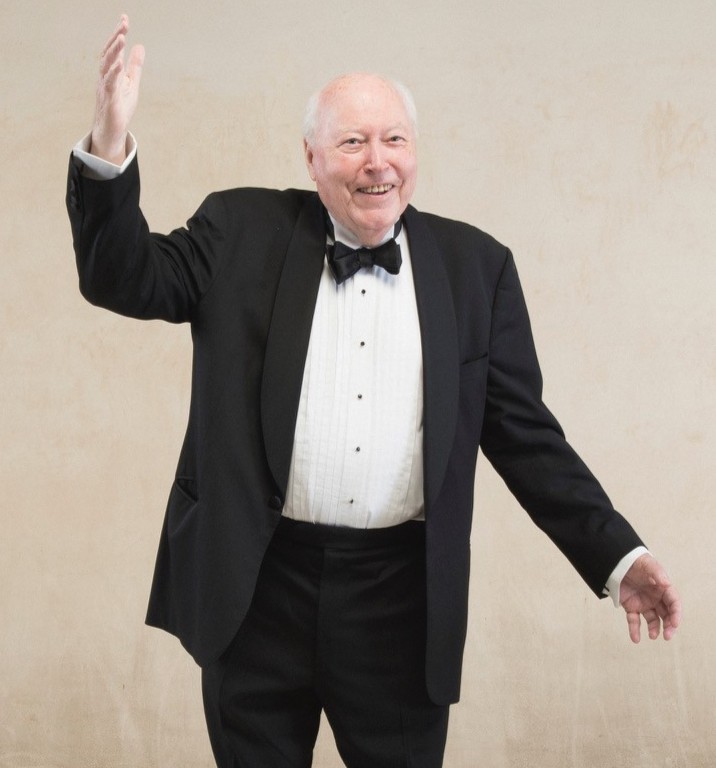
The volume marked Martin’s retirement from the Agnelli-Serena Chair of Italian at Oxford, and its introduction began: ‘Martin McLaughlin was born on 4 December 1950 in Glasgow, where he grew up in a large, happy family of eight brothers and sisters.’ 

He studied Classics at Glasgow University from 1968, graduating with First Class Honours in 1973. He was soon made aware of a scholarship to Balliol College for Glasgow University graduates, endowed by John Snell in the 17th century. Around this time, Martin went to Italy, realised that he could not speak a word of Italian, but managed to communicate, with selected interlocutors, using his fluent Latin. 

When he moved to Balliol, he studied Classics and Italian and obtained a First Class Honours degree in 1975. He began a DPhil in 1976 under Professor Cecil Grayson, focusing on literary imitation in theory and practice in Italy between 1400 and 1500. A year later, he was appointed Lecturer in Italian at Edinburgh University, where he remained until 1990 before returning to Oxford as University Lecturer in Italian and student of Christ Church. In 2001, he was elected to the Agnelli-Serena Chair of Italian Studies and became a Fellow of Magdalen College. 

In 1995, Martin published with Oxford University Press a fundamental study for the Humanities, entitled Literary Imitation in the Italian Renaissance, partly based on his doctoral thesis. 

Martin’s interests spanned the whole Renaissance period. He became an established authority on the works by Leon Battista Alberti (1404–1472), dealing with painting, perspective, mathematics, as well as husbandry – topics partly covered in his British Academy Italian Lecture in 2009. He also translated Alberti’s Autobiographical Writings for ITatti Renaissance Library, published by Harvard University Press in 2023. But, as a true ‘Renaissance man’ himself, he also dedicated far-reaching studies to numerous modern and contemporary authors such as Umberto Eco and Antonio Tabucchi, as well as translating many works by Italo Calvino, including his Why Read the Classics? which won the John Florio Translation Prize in 1999–2000. In 2008, his achievements were recognised by the President of the Italian Republic with the title of Commendatore.  

The Bibliography of Publications by Martin Mc Laughlin is included in the volume mentioned at the beginning of this obituary (pages 28-32), and lists five substantial books, 11 edited volumes, 11 translated books, and 72 chapters in books and articles in journals, as a testimony of his constant activity. 

Martin was known by students and colleagues, both in this country and abroad, as an extremely helpful and generous teacher, a lover of football who enjoyed life to the full and always appreciated the whimsical aspects of literary and academic work. All his photographs, taken at lectures and conferences, show him smiling, and that is how we shall remember him. 

Martin died peacefully in Oxford on 24 January 2025, after a prolonged illness. 

He is survived by his wife Cathy, his daughter Mairi, and granddaughter Iona. 

1. The Festschrift was edited by Guido Bonsaver, Brian Richardson and Giuseppe Stellardi, and comprises 28 essays for a total of 443 pages.

Richard Tilney-Bassett

1955, BA Botany
19 January 1936 — 20 January 2025

George Vayakis (1984)

It is with great sadness that I reflect on the loss of Richard, who passed away this January, aged 89 exactly. Care in thought, speech, planning and action, combined with an underlying calm kindness, characterised his life. He came to Balliol in 1955 for botany and left with a DPhil in plant genetics. This became his life’s work. He was part of the first team to demonstrate extra-cellular inheritance, going on to train many doctoral students to appreciate mathematically rigorous analysis of inheritance in plants, mainly in pelargoniums. Richard’s way was reserved and quiet. He thought hard and deep. He always tried to support those around him and saw the same potential in all, irrespective of appearance and background.

In Oxford, he met my mother-in-law, Beth, marrying her in 1963. Like many who tread the scientific mill, they moved a growing family around post-doctoral and sabbatical stints, in the Germanies and France. Their daughter Amanda followed him in Balliol for Biochemistry and their son Jeremy became an aircraft design and quality engineer. They raised them in Gower, where Richard was a reader at the University of Swansea and Beth taught art. Naturally, they transmitted to their children a love of beauty in nature and art, the sea and the outdoors. But it was life in France, tested early, that seems to have suited them best. On retirement, they made a home for all in Finhan, in the French southwest. Beside the company of family and friends, Richard enjoyed keeping abreast of his field and science developments in general, managing a large garden, and travelling. He looked after Beth through her years of declining health until  2019, and supported his four grandchildren, dispersed at times worldwide. He loved a good joke and a good dinner, and he took a keen interest in the life of people he met. He diligently tried to improve his French until the end, remaining British and European in his outlook. He had fond memories of the College and was sad when, at the last minute, he was prevented from attending the 2022 Gaudy. So, I pass on his message, absorbed through his life and behaviour: be demanding –  mainly of yourself – thoughtful, and kind. 

Martin Foley

1951, BA Modern History, Foundation Fellow since 2007
27 April 1932 — 16 January 2025

Andrew Graham (Fellow and Tutor in Economics 1969-2001, Master 2001-2011, Honorary Fellow)

Martin FoleyMartin Foley first entered my life via an unusual route. I was in Balliol, working late, when the phone rang. It was the Development Director asking if one of the undergraduates involved in the College’s telephone fundraising campaign could see me. The student arrived and breathlessly reported that they had just telephoned an alumnus in Mexico, that the call had rapidly become somewhat tetchy and came to an abrupt end. However, just before the phone was put down, the alumnus said ‘I have to go but I'll give you £100,000’!  
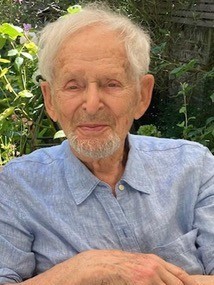
That was the start of Martin’s long association with Balliol as one of our most generous and involved donors. Following further donations, he endowed in perpetuity the Foley-Béjar Scholarships. These are open to students with a place at Balliol to read any subject, whether at undergraduate or graduate level, provided they have lived for some substantial time in Mexico, Spain or Ireland, and have at least one parent born there. He later founded the Mexico Explorer Awards – akin to the Coolidge Pathfinder scheme in purpose – supporting a pair of Balliol students to spend 4–8 weeks in Mexico at the end of their degrees. Martin’s long-time interest in the arts and culture resulted in the donation of Feliciano Bejar’s Molusco II sculpture ceremonially installed at Holywell Manor. Martin also donated to the Ashmolean Museum, especially in support of their ceramics’ collections.  In recognition of his generosity, Martin was made a member of the Chancellor’s Court of Benefactors, and a Foundation Fellow of Balliol. He was a regular and warmly welcomed attender at many Balliol events, until ill health finally precluded him travelling from Mexico.
 
But all that was yet to come. At the time of the seminal phone call, I had not met Martin, and it was several years before I heard his version of the story of that first donation. It turned out supporting Balliol had been a quiescent thought. On the day of the call, he and his partner, the exceptional Mexican artist Feliciano Béjar, are about to go out to lunch. They plus their gang of adopted children are jammed into the car when someone rushes from the house saying there’s a call for Martin from a UK university. An irritated Martin runs in to take the phone. Outside the car is hot, the children are arguing, Feliciano is shouting at the top of his voice – ‘come on’, ‘come on’.  And, out of desperation, Martin makes his extraordinary first gift to Balliol. For years afterwards, it remained a source of amusement.

As anyone who has met Martin will attest, he was a man full of acute perception, with well-tuned aesthetic sensibilities and an endless supply of surprising stories – stories which often meandered down byways of substantial complexity before, finally and often suddenly, returning to the main point. One result is that it took me some time to make sense of the jigsaw of Martin's life. There was nothing linear about it in any way whatsoever.

Martin Antony Oliver Foley was born (27 April 1932) in Derbyshire to a family of mixed cultural roots – Irish, English and Welsh. Schooled at Chesterfield in England, his identity was also shaped by strong emotional ties to Ireland through his father’s Sligo background. Thus, Martin’s early years were split between England and frequent trips to Sligo to see his Irish grandparents of whom he was very fond. As recounted by Martin’s adopted son, it was a childhood filled with local adventures, vivid characters, cultural contrasts and a growing awareness of religion, art and identity that, as those of us who knew Martin in later life can attest, remained a part of him throughout. Following national service in the RAF at Innsworth in Gloucestershire, he came to Balliol to read History.

That religion played a central role in Martin’s upbringing, shaping his education, community life and creating a fascination with churches seems indisputable. His Sligo father, Bartly (short for Bartholomew) Foley, was Catholic, and his mother, Winifred Greenan, a Protestant Yorkshire lass, had converted to Catholicism in her youth, much against the wishes of her family. At Balliol, the tutor with whom he most identified was the distinguished medievalist Richard ‘Dick’ Southern (1929), and it seems very probable that this further encouraged his already existing interest in Catholic ecclesiastical history.  

Post Balliol, Martin’s first job was with De La Rue – printer of money and playing cards. Martin was never a money chaser, finding games and cards far more to his taste. Whilst at De La Rue he not only produced two full catalogues of existing games but also devised a few himself - Cards for Two, Travel Agent, and, for children, Cards on the Table. More significantly, at least for the card industry, he played a role in reducing the taxes they paid. Back then, every pack of cards had a wrapper and a seal and with this went a tax. Someone working for Waddingtons, the main competitor to De La Rue, recorded, ‘a lively lad called Martin Foley had the bright idea of persuading the authorities to abandon the duty and the wrapper. He succeeded in 1960’. Martin also used this time to organise a gathering of most of the great contract bridge players in the world. Whether it was the success of this event or his work on tax, history does not reveal, but on 1 October 1959 at the Apothecaries Hall, Martin Foley, Manager of the Playing Card Division of Thos De La Rue & Co. Ltd, was admitted to the Livery of the Worshipful Company of Makers of Playing Cards.

During this same period, Martin spent many summer holidays in Spain, especially in Barcelona and in the small village of Alella, learning Spanish, following his interests in Catholic churches and indulging his interest in dance. Indeed, in his second year at Balliol whilst living on the main site, his Irish dance classes made so much noise that the Physics tutor, Dr Kuhn, complained that the ‘whole house is shaking’. Despite this, once he moved to Holywell Manor for his final year, the Irish dancing classes reappeared. And in Spain, he was especially drawn to the traditional Catalan dance – the Sardana.  

It is unclear whether De La Rue was more impressed by Martin’s general initiative or by his knowledge of Spanish – whichever it may or may not have been, around 1960, they sent him to New York charged with obtaining a contract from the Mexican government to print the country’s money. According to Martin, all went well until the Mexicans realised their money was to be printed outside Mexico! This was, of course, entirely correct from a security viewpoint but a huge affront to Mexican pride. The contract duly ‘went south’, and so too did Martin, finding Mexico City much more in line with his interests and inclinations than De La Rue and New York ever were.

It was in Mexico that Martin’s friendship began with Feliciano Béjar, who was already recognised as a significant Mexican artist. It was a partnership which lasted 40 years. Both were hugely committed to the education and care of young people, and soon found themselves with an enormous ‘adopted’ family – at one point totalling nineteen. Feliciano was from a tiny, very poor Mexican village. He was completely self-taught, learning elementary carpentry and building, often using scrap materials which he turned into art.  Many of his early pieces examined how light was reflected in unusual ways, in a style of sculpture that became called ‘magiscopios’.  He and Martin found a good-sized plot of land about ten miles south of Mexico City and this was where Feliciano built the ‘fascinating artistic-colony-community’ (as his friend, Timothy Wilson, called it) that became the base for him and Martin, their expanding family, and Feliciano’s studio and art.  At first it was a single house, but as children were added so more houses appeared, and, at one point, an open-air theatre. This construction (more accurately a series of constructions) was mostly made with reclaimed old doors, pillars, architraves, chimney pots, stonework, carvings all being cast out as ‘rubbish’ from traditional Mexico City centre buildings as the city redeveloped. Feliciano found a use for it all and initially brought much of it to the site via donkey and cart. At the time they acquired the land it was undeveloped, quiet and almost rural. By 2004, when Peggotty and I visited, a dual height, six lane motorway was being constructed running right along the boundary, with high-rise buildings all round. Such is the price of progress.

At some point not so very long after Martin’s arrival in Mexico came a second curious twist in his life. As indicated already, he was always fascinated by dancing and folk art and local customs – everything that gave a sense of the real Mexico and its cultural identity. Returning from a festival at a remote village, his driver overtook the car in front only to realise that Martin had collapsed in the backseat. The car screeched to a halt. Martin was found to be suffering from carbon monoxide poisoning, and helping to rescue him was the passenger in the car that they had just overtaken – the Mexican Minister of Culture. The next day she visited Martin in hospital, and I am told that after only a few preliminary remarks she said to Martin that he obviously knew about business, and he was interested in dance and so would he become Director of the Mexican Folk Ballet?  Thus, for four years, Martin became the General Administrator and Technical Director of the Ballet Folklorico de Mexico – and, on at least one occasion, Feliciano designed the sets.

I know little else of Martin’s life during this period but, from his conversations, I sensed that he felt fully at home – a Spanish speaking, Catholic country with a rich history and an immense depth of local art and culture. His friendship with Feliciano blossomed and he was able to indulge his eye for ceramics, folk dance and folk art. He devoted much time, not always successfully, to seeking greater international recognition for Feliciano. Despite help from his Balliol friend, John Mallet (1950) and his wife Felicity, he had little success with the Cork Street Galleries in London, but made more progress in New York, where Feliciano had had his first exhibition as early as 1948. Following Feliciano’s death in 2007, Martin dedicated himself even more energetically to preserving and honouring his artistic legacy, creating a museum in Jiquilpan in the house where Feliciano had grown up and establishing the Feliciano Béjar Foundation in 2014. This now encompasses three museums, one of which –  Casa Atlamaya – is at the home Martin and Feliciano shared for over 40 years. And where, surrounding them, were the many children they helped on their way to adulthood. One of them – Martín Feliciano Béjar – was formally adopted as Martin’s son.

The passion that Martin and Feliciano had for improving young people’s future shone through not only in the children they rescued from the slums of Mexico City but also in Martin’s subsequent generosity to Balliol. His interest in endowing the Foley-Béjar Scholarships was deeper than that of many, but of course not all, benefactors. He liked to meet and mentor students and frequently became good friends for life. The very first of these Scholars, Miriam Bazan-Peregrino (2003), writes:

‘Growing up in a poor village in Mexico, attending Oxford would have been an impossible dream without the generous support of the Foley-Béjar, CONACYT, and Clarendon Funds. These scholarships covered everything – from tuition fees to living expenses – and made my education possible. But what stood out about Martin was his personal engagement. Shortly after I arrived in Oxford in 2003, I received a handwritten letter in Spanish – and this marked the beginning of many more handwritten letters and, later, long emails that continued over the years. Later, he came to my wedding and told the story of the evening when Andrew and Peggotty were at his house and, in my enthusiasm to show my Balliol commitment I peeled off a coat and a jumper to display, with pride, the sports top I was wearing – an item I had designed as the captain of the newly-formed Balliol Women’s Basketball team. As Martin teasingly recounted this, he said he had wondered quite how many layers might come off! He was a warm, generous, acutely observant man and I miss him greatly.’

Peggotty and I only met Martin in his mature years, but we rapidly became close friends. While we were living in the Kings Mound, Martin stayed with us whenever he came to Oxford, sharing long discussions over the breakfast table. During this time and for many years following until not long before Martin’s death, Peggotty and he corresponded regularly, sometimes about arrangements for a visit, more often exchanging news of what each was doing coupled with what some might term ‘quizzical’ views about the ways of the world. Martin was as acute in his observations in correspondence as he was in ‘real’ life – and they shared a sense of the ridiculous and life’s many stupidities just as they valued the beauty of life all around too. They got along pretty well! One very special thing about which we were and remain immensely touched is the email Martin sent to us on hearing that I was about to step down as Master:

For me, Balliol without you really will be a different place as you have both helped make it a home for me which it never was before. I now feel an integral part of it physically and spiritually, whereas earlier it was an important part of my life, but a separate room as it were – certainly a large important room, say a dining room as it's Oxford – in a big house. Now it's a whole self-contained unit, a grandpa flat, to continue the idea. Apart from your personal friendship which I treasure, you have made my connection with the College very special…

What more could one want? Well, nothing. But there is just one other event that I especially recall. It was a Friday evening in February 2008. Peggotty and I were about to hold a party that weekend. We liked giving parties and the excuse for this one was to celebrate ten years of my Mastership. Martin was on the phone and said, ‘I am on my way’.  Yes, he loved Balliol and could afford to come, but it still took much time and effort, and it was a very sad time for him as Feliciano had only recently died. He arrived and Peggotty gave him a big hug. It was a very special friendship – one that we continue to feel blessed to have had.

Martin died on 16 January 2025 at the age of 92 in his home in Mexico City under the loving care of his adopted son, Martín. A few months later, his ashes were brought by Martín via Balliol en route to County Sligo. The ashes rested in Balliol Chapel overnight. At a small ceremony in the quad at Holywell Manor, we stood by the sculpture of Feliciano’s Mollusco II that Martin had donated to Balliol in 2010 and toasted the life of a man with a great affection for Balliol – a man full of generosity and good will. The Foundation Fellowship to which he was elected in 2007 was exceptionally well deserved, and we remember him with great affection.


John Ager

1952, DPhil Inorganic Chemistry
2 November 1926 — 22 November 2024

Geoffrey Owen (1952)

We are sad to report the death of John Ager, an American who came to Balliol in 1952 to study for a DPhil in inorganic chemistry. He was best known as an outstanding tennis player – he was the University’s top player and did well at Wimbledon – but he also had a successful career in industry as a research chemist. He died at his home in Princeton, New Jersey, on 22 November 2024, at the age of 98.

Born in Birmingham, Alabama, in 1926, he moved with his family to Black Mountain, North Carolina, and graduated from the nearby Asheville School in 1944. He served for two years in the US Navy, mainly in the Pacific theatre in the closing years of the war.

Returning to civilian life, he had an impressive academic record at Harvard as well as considerable success in sport. He was captain of the fencing team and a member of the Harvard/Yale tennis team which defeated the Oxford/Cambridge team in the 1948 Prentice Cup competition. After Harvard, he won a Fulbright scholarship which enabled him to continue his studies at the University of Amsterdam and then at Oxford.

Having played for Harvard and Yale in 1948 Prentice Cup match, he had the unusual distinction of also playing for Oxford and Cambridge against the Americans in the 1954 Prentice Cup event, which was held in London. (The long-established Prentice Cup contest, which still continues, is played every two years, alternately in the US and in Britain).

John played in the singles and doubles at Wimbledon in 1954 and 1955, winning several rounds in both events.

After returning to the US, he worked as a chemist, first at Olin and then at FMC Corporation. He was awarded several patents for his research in the field of agricultural chemicals.

John met his future wife, Sheila Wilcox, at Oxford; she was studying modern history. They lived at first in Buffalo, New York, but later moved to Princeton, where Sheila taught Latin and history at a local school; she predeceased her husband in 2015. They are survived by their son and daughter and five grandchildren.

As a fellow member of the Oxford tennis team, I had a huge admiration for John, not just for his tennis prowess, but for his unfailing support and encouragement for less talented players.

For Balliol, he was perhaps an unusual recruit, more at home in the laboratory and on the tennis court than in the College common room, but all who knew him will remember him with the greatest affection and respect.


An obituary can be found at the following website:

John Ager, Jr. Obituary Nov 22, 2024 - Blackwell Funeral Home

Brian Knox

1951, BA Modern History
22 February 1932 — 21 November 2024

Lesley Knox

Brian was born in 1932 in Farnborough, the son of a British army officer from Northern Ireland. His grandfather D.B. Knox was a Presbyterian minister, well known for his sermons and had three volumes published in the 1920s. The family were descended from one of John Knox’s daughters, who moved to Northern Ireland when she married.

He was educated at Winchester and Balliol College, Oxford, where he studied ‘Modern’ History, defined in his day as up to 1273AD
In 1954, he joined the stockbroking firm of Grieveson Grant and Co., becoming a partner in 1961. Over time, he served successively as head of UK Research, the partner responsible for developing business in Japan, and finally as one of the creators of the European department. 

In 1986, Grieveson was acquired by the British merchant bank Kleinwort Benson, of which Lesley was a director – though she and Brian had never met until they both tried to buy the same picture at the Angela Flowers gallery. They married in April 1991 and had Fenella, their daughter, in June 1994.

Brian also pursued a parallel career as a historian of architecture. In 1961, he published Bohemia and Moravia-an Architectural Companion, which was later revised as Architecture of Prague and Bohemia. His next publication was The Architecture of Poland. 

His final book, finished during COVID-19, tells the story of the five houses he built (four with Lesley): one in London, one in France, two in Edinburgh, and one in Harris, in conjunction with different, extremely talented but also patient architects. 

Alan Montefiore

1948, BA PPE, Fellow and Tutor in Philosophy 1961-1994, Tutor for Admissions 1962-1967, Emeritus Fellow from 1994
29 December 1926 — 29 October 2024

Andrew Graham (Fellow and Tutor in Economics 1969-2001, Master 2001-2011, Honorary Fellow)

Alan MontefioreI sometimes remark that being at Balliol is rather like having a stone in your shoe – tiny relative to your body mass but altering the whole way you walk. Alan Montefiore had much the same impact. Initially, I was too much in awe of him to think clearly about what was going on, but I gradually came to understand the shape of his conversations. At the start, he often appeared sympathetic to whatever position one had taken, but a few steps down the road, he would be inviting you to realise that you must have been mistaken as you were now so clearly contradicting yourself.  
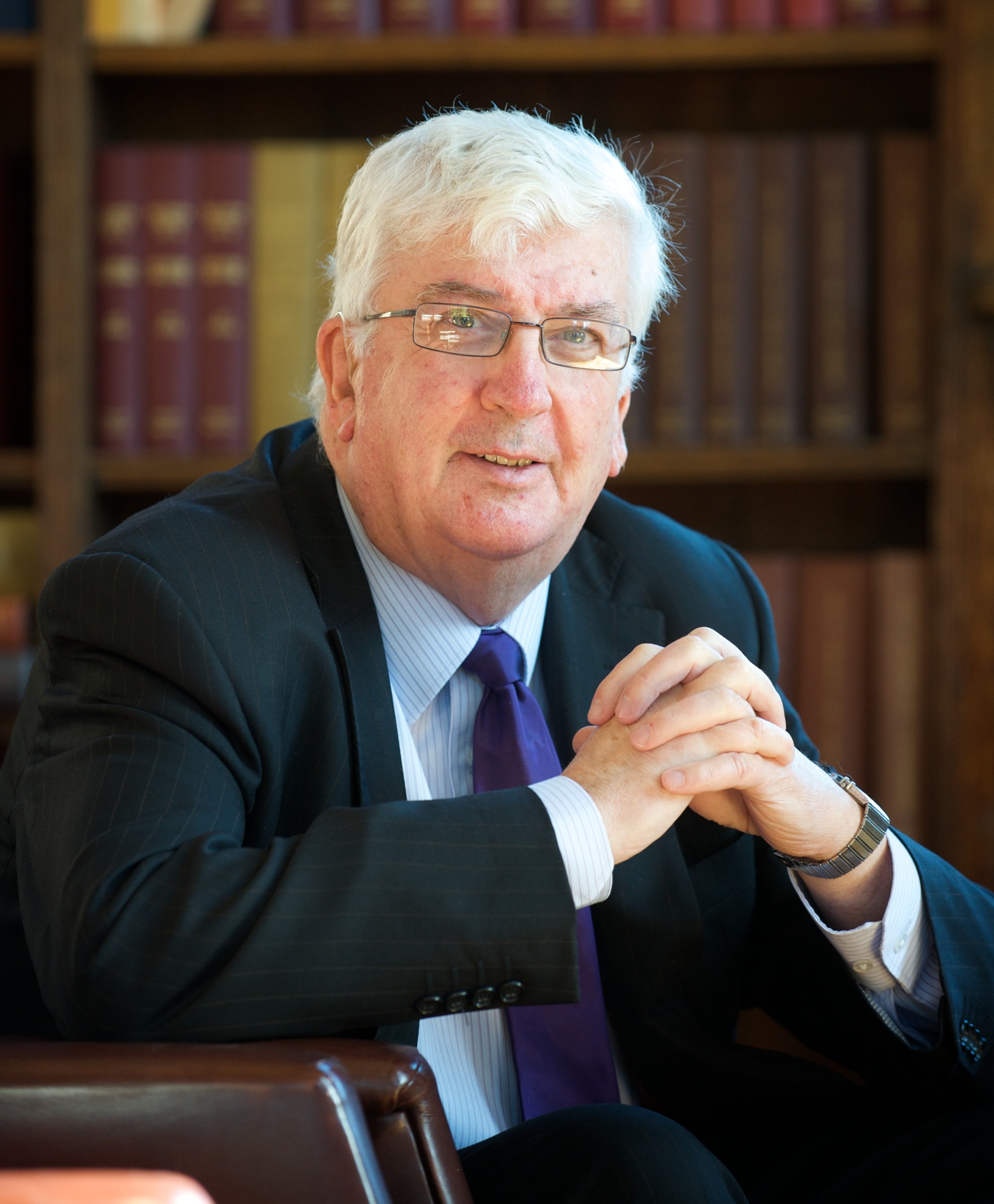
Over the years, the ‘Alan stone’ led me to see three things, obvious to philosophers, but often overlooked in general discussion. First, if a line of reasoning leads to a contradiction or clashes with reality, either the logic is mistaken, or the starting assumptions are adrift – the latter a particular affliction in economics.

Second, if you are going to have a discussion – rather than a shouting match – there must be something on which you agree. Alan illustrated this vividly in one of my very first encounters. He had been in Singapore on sabbatical in 1968 and had listened to the broadcasts by the Americans and by the Chinese (I later learned that part of his National Service had been spent in Singapore and that he could speak Hokkien). Their accounts were diametrically opposed, yet on one issue they were agreed – there was a war. 
Third, most of our claims about the world are context dependent. Alan was impressive across the board, but to my mind where he excelled and where he made his greatest contribution was in teasing out how the context mattered – whether that context is internal (who am I and to whom do I owe commitments?) or external (in what ways has this idea been seen differently in varying cultures and languages?).

When Alan started teaching at Balliol, Oxford analytical philosophy, concentrating heavily on logic and the philosophy of language, was at its height. An ‘is’ was never to be confused with an ‘ought’. The positive and the normative were not only in different boxes but needed to be kept so. However, from early on, Alan, bilingual in French, had an interest in Continental philosophy where context was allowed full sway, especially the position of the speaker. Or, as Alan might have put it, given the fact (an ‘is’) that he was born Jewish, this entails an obligation (an ‘ought’) to that faith, or to that community.

Once the study of Kant was brought formally into PPE in the 1960s, Alan began a seminar devoted to Kantian philosophy. The seminar soon became legendary. In the collection of essays marking Alan’s 85th birthday, no fewer than six contributions were devoted to it, with Michael Sandel (1975) writing that it was ‘a centre piece of academic life at Balliol’. 
Alan was a wonderful example of the engaged intellectual, willing not only to think but to act. When the Wiener Holocaust Memorial Library faced a funding crisis in 1980, it was Alan who stepped in and persuaded the former Prime Minister, James Callaghan, to become the first President of the Endowment Appeal. Alan was the Governor of the Froebel Educational Institute (which later became part of the University of Roehampton) and, alongside his Balliol work, he was actively engaged with Kathy Wilkes (St Hildas) and his Balliol colleagues, Tony Kenny (Fellow 1964–1978, Master 1978–1989) and Bill Newton-Smith (Fellow and Tutor in Philosophy 1970–2005), in organising underground seminars with dissidents in what was then Czechoslovakia. He was a founding member of the Jan Hus Educational Foundation which backed this work and in 2019 he was awarded the Czech Honorary Jan Masaryk Silver Medal.

After retirement, he and his second wife, French philosopher Catherine Audard, founded the Forum for European Philosophy, which ran weekly seminars at LSE for 25 years, broadening access to diverse philosophical traditions. Catherine was the Chair, and they worked closely with three former pupils, Simon Glendinning, Hilary Lawson (1972) and Paul Flather (1973). He continued to write, producing, amongst others, A Philosophical Retrospective (2011) and Philosophy and the Human Paradox (2019). In his 97th year, he was as sharp as ever, and was in Paris with Catherine, doing The Times cryptic cross word when his fatal heart-attack struck.

Alan was born in London in 1926, the son of Leonard Montefiore (the first President of the Wiener Library), and grandson of Claude Joseph Goldsmid Montefiore, a theologian and the founder of the London Society for the Study of Religion. He was educated at Clifton College, Bristol, earning high praise from them for his multiple talents, including ball games, especially squash. His housemaster wrote in his final report, ‘No other boy within my experience has won so much affection and respect from both masters and boys throughout the school’.

Many years later, I learnt to my cost how skilfully he played squash when I spent a Sunday morning scrabbling desperately to rescue the ball from corner after corner as Alan stood at the centre nonchalantly dispatching my returns. In squash, good players focus not on where the ball was hit, but where it will land. Later, I saw an analogy with arguments. Especially when discussing with someone as clever as Alan, it paid to think as much about his desired end point as about the current move.

After three years of National Service, much of it in Singapore, Alan came to Balliol to read PPE in 1948 – he had been admitted in 1945 but demobbed only in 1948.  He had first considered Classics, then English, before settling on Modern Studies, as PPE was known. In 1951, he took up a teaching post at Keele University. Keele had only been founded the year before (the moving force being ‘Sandy’ Lindsay, Master of Balliol 1924-1949), and the story is that Alan was in the quad when his personal tutor called down to him that Keele was seeking young lecturers, so why not apply? Around the same time, in March 1952, Alan married Hélène (née Pivant) in Paris. Since she was a gentile, neither of his parents came to the wedding, and his mother avoided speaking to Hélène or even seeing her first granddaughter for several years. Alan and Hélène had three children: Anne, a counsellor, Claire, a psychotherapist, and Paul, a photographer and interior designer.

In 1961, armed with impressive references from, amongst others, ‘Sammy’ Finer (Lecturer in Politics 1946–1949, JRF in Politics 1949–1950), who had also moved from Balliol to Keele, and Stuart Hampshire (1933), he was elected to a Fellowship at Balliol, where he remained until his retirement. In 1984, he married Catherine Audard, bringing her children, Sylvain, Laure-Hélène, and Florence, into his life, and he and Catherine worked intensively together for the remainder of his long life. 

In addition to, and entirely in tune with, his interest in continental philosophy, Alan believed strongly in multi-disciplinary exchange. Bill Weinstein (Politics Fellow) and I (Economics Fellow) contributed to his 1975 volume on Neutrality and Impartiality: the University and Political Commitment – an issue right back in the news as I write. In 1997, he edited Integrity in the Public and Private Domains with economist David Vines (Emeritus Fellow), and in 2021, Goals, No Goals and Own Goals with physiologist Denis Noble (Emeritus Fellow).

Steven Lukes (1958) has memorably described Alan as the ‘Le Grand Anti-simplificateur’. This brilliantly evokes Alan's multidimensional manner of thinking, as well as what I regard as his highly ‘leveraged’ way of arguing. By ‘leveraged’, I mean the way in which Alan could focus on what, to most of us, might seem a quite narrow issue where a decision was required, and show that, viewed with more thought, it had geopolitical implications. In the nicest possible way, this tended to happen most when he hoped one might change one’s mind or could be persuaded to do something – if only one had the breadth of intelligence to see the light. On one occasion, we were about to turn down an applicant for admission, when Alan brought into play that the applicant’s first language was German and that, philosophically, what he had been trying to argue would be much richer in German. We duly re-interviewed him in German – and admitted him. 

Steven's description should not, however, be taken as implying that Alan was unclear. Complex – yes; unresolved – sometimes; lengthy sentences with multiple qualifications – frequently; but lack of rigour – rare. Indeed, his contributions remain of value precisely because he bridged and combined the sharpness of analytical philosophy with the breadth and imagination of continental philosophy. 

Nor does Stephen’s moniker well describe Alan’s interactions with his students which were often forthright, perceptive, and straightforward. After just a single tutorial, he asked a student from India whether they were feeling homesick. They were and were very touched that Alan had noticed. A second was told in no uncertain terms that the difficulties with his family could not be side-stepped. He had to confront his father. A third was told to rewrite his essay leaving only the first sentence of each paragraph. If a clear argument remained, carry on. If not, start again. The last is always good advice, but it was especially suited to its recipient, a clever student, but easily distracted. 

He was also always on the side of his students. On numerous occasions, the poor performance of X or Y was reported to Tutorial Board with suitable disciplinary action seemingly inevitable, until Alan spoke. His remarks were often complex, but, in essence, suggested that we (the other Tutorial Fellows) had failed to see the full picture. It often took time, but Alan frequently prevailed. As one former colleague said when I suggested the ‘stone in the shoe’ analogy, ‘I like it. It captures not only his influence but also his persistence’.

In many ways Alan was a simply wonderful colleague – supportive and challenging in equal part, keeping one’s wits alive, and endlessly opening new avenues of thought – and everyone, young and old, speaks of how they were always treated as his intellectual equal. But I wish to emphasise a deeper contribution that I personally think Alan made. PPE is often regarded merely as an interesting joint degree that allows students to study three social science disciplines alongside one another with little real connection between them. That has never been the Balliol view and, most assuredly, was never Alan’s view.

The key question is this: are economic theorists better for having done philosophy, and philosophers better for having done politics, or are these three subjects necessarily inter-related? Alan, I am sure, was convinced that the connections between the disciplines were essential. He would have expressed it in a more nuanced way, but I believe that he regarded theories based on the assumption that the person exists ‘as if’ they are independent of society as fundamentally flawed. He felt it essential to inquire what it means to be a person. Alan especially liked Hume’s confession that he, Hume, could not answer this question; and he believed that once this question is addressed and once the person is contextualised, there are deep implications for all three sides of PPE.

Moreover, this philosophical underpinning, I suggest, has provided both an element of continuity and an element of difference to PPE within Balliol and I see Alan as having been an exceptionally significant contributor to this distinctiveness.

Certainly, the prevailing Balliol view of PPE stands in sharp contrast to the study of the social sciences in many other universities (and even most other colleges in Oxford), where ‘economic science’, ‘political science’ and ‘formal logic’ are seen as entirely separate disciplines.  For me, Alan’s insistence on context and on the fuzziness and complexity of the connections between facts and values are not just quirks of his but derive from a deep philosophical underpinning and is a core part of what made – and makes – Balliol PPE distinctive.

This same Balliol continuity can be extended to include many of the people with whom Alan interacted or whom he taught. I think, for example, of Bernard Williams (1947), Akeel Bilgrami (1971), and Stephen Mulhall (1980) in philosophy; Charles Taylor (1952), Michael Sandel, Steven Lukes and Rajeev Bhargava (1975) in political theory; and, in economics, Tommy Balogh (Fellow 1945–1973, Emeritus Fellow 1973–1985), Paul Streeten (1944), Wilfred Beckerman (Fellow and Tutor in Economics 1964–1969 and 1975–1992, Emeritus Fellow 1992–2020) , Hugh Stretton (1946), and Keith Griffin (1960).

Of course, at Balliol we also believe passionately in diversity and, if Balliol had a motto, it might well be ‘The promotion of heresy’. The delineation that I have sketched therefore has had many distinguished exceptions. Nevertheless, when I observe the extent to which in much of the non-Balliol world, the curricula of politics and international relations have tended to be formalised and de-contextualised (especially in the obsession with game theory), and how much philosophy has become focused on logic, and how economics has become a branch of mathematics, it underlines the distinctiveness of PPE as studied at Balliol. If this claim about the difference in approach at Balliol is even remotely true, it is an extraordinary achievement. It is very rare for even a university to have sufficient strength of tradition for it to count as a ‘school’ (Chicago economics is an exception that illustrates the point), but, apart from Balliol, it is unheard of for a single Oxford or Cambridge college to represent a ‘school’.

Perhaps I push the point too far, but I would not be tempted to do so were it not for the influence of Alan. He did not start the tradition, but he revived it, amplified it, filled it with rich furniture, caused many of us to expand our intellectual boundaries, and passed it on, greatly enhanced, to the next generation of students and teachers. Thank you, Alan.


Professor Alistair Ulph

1968, MPhil Management Studies
26 October 1946 — 05 October 2024

Professor David Ulph (1968) 

Alistair UlphAlistair M. Ulph was a distinguished academic and economist who died on 5 October 2024. He had been suffering from Motor Neurone Disease. 

Alistair and his identical twin, David, were born within five minutes of each other in October 1946. In 1958, they entered Hutchesons’ Boys’ Grammar School in Glasgow. They later went up to Glasgow University, where Alistair graduated in 1968 with a First-Class Honours degree in Statistics and Political Economy. Both went on to pursue postgraduate studies at Balliol, where Alistair graduated with a BPhil in Management in 1970. 

Alistair was appointed to the Oxford Business School, where he worked on timetabling algorithms with then Balliol Fellow, Michael Dempster. In 1972 he joined his brother in the Economics Department at the University of Stirling, where they started a fifty-year research collaboration on a wide range of topics. In 1974, he was appointed to a Fellowship at the Centre for Research in Environmental Studies at the Australian National University, which sparked a life-long interest in environmental economics, particularly the economics of climate change. 

In 1979, he took up a lectureship in Economics at the University of Southampton, where he rose to become Professor of Economics (from 1985), Dean of Social Sciences (1989–1992), and Deputy Vice-Chancellor (1995–2001). 

He moved to the University of Manchester as Deputy Vice-President and Dean of the Faculty of Humanities from 2004 to 2010. Since the university had just been created through a merger, it was a time of considerable uncertainty. However, Alistair was highly regarded by colleagues for the compassion and vision with which he steered the Faculty. He was an institution builder, launching a major initiative on social change between Manchester and Harvard, and founding the Sustainable Consumption Institute. 

In addition, Alistair was an illustrious researcher, producing over 120 papers and two books, and editing six others. He conducted ground-breaking work on the economics of climate change, particularly on the link between trade and environmental policy. His careful research challenged many widely held views. 

He served as President of the European Association of Environmental and Resource Economists from 2000 to 2002 and was appointed Fellow of the Association in 2019. 

He leaves a much loved and loving family: his wife, Nanette; two daughters, Karen and Fiona; and granddaughter, Sophie. 

He had a wry sense of humour, and, despite his great distinction, was a humble man. He will be sorely missed.